Acupuncture Point Names: Using Poetry to Touch the Soul
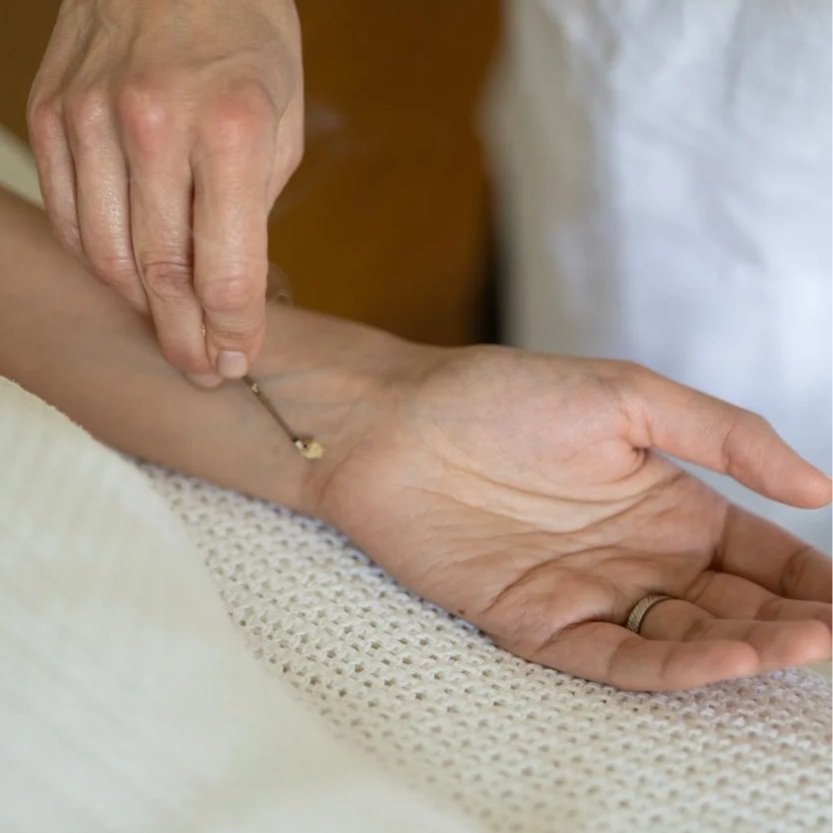
In my clinical practice, I often use moxibustion (small cones of a dried herb called mugwort) to warm up the acupuncture point prior to needling it. Warming up the point not only promotes blood flow and the flow of Qi, but it also calls upon the ‘spirit of the point’ – the complex, evocative imagery expressed in a point name. During treatment, I often share these names with my patients.
‘The names of the [acupuncture] points are not merely nominal,’ wrote the great seventh-century Chinese physician Sun Simiao. ‘Each has a profound meaning.’ The spirit of the point reveals how Five Element acupuncturists use poetry to touch the soul. By including them in treatments, we allow the ancient wisdom and beauty contained in point names to become a part of the treatment process itself.
For example, the names of points on the upper chest along the Kidney meridian signify a journey from despondency to the return of hope, such as Lingxu: ‘Spirit Burial Ground’ (Kidney 24) and Shencang: ‘Spirit Storehouse’ (Kidney 25).Here is acupuncturist Lois Francis on Kidney 24 (‘Spirit Burial Ground’):
The names reflect the principle that acupuncture points are not only links affecting the flow of energy, but also portals to specific aspects of a person’s being. Just as needling points redirects the Qi coursing through the body, speaking the point names during treatment can open up new possibilities for patients in chronic states of physical and/or emotional distress.
At some point in our lives, many of us experience a state of confusion that clouds our sense of purpose, in which we grasp for ways to frame our existence intelligibly. At the root of such a state lies a crisis of connection to nature and community: we live in an overly individualistic, disconnected world. By contrast, to the ancient Chinese observer, there could be no separation between human beings, the natural world and the universe.
Eminent scholar and practitioner of Chinese medicine Heiner Fruehauf has said that ancient practitioners used poetic symbolism as a way of deepening our understanding of how human beings relate to nature. In considering the body, they saw not inert flesh, but power and functioning and movement: the essence that resides in a particular point in the body, what that point is supposed to do when the body works well and what symptoms might arise when that function is disturbed.
Further Reading
Ellis, Andrew, Wiseman, Nigel and Boss, Ken (1989), Grasping the Wind: An exploration into the meaning of Chinese acupuncture point names, Brookline, MA: Paradigm Publications.
Francis, Lois (2017), Spirits and Functions: A Guide to The Energetic Qualities of Acupuncture Points, Independently published: Kindle edition
Fruehauf, Heiner (2011), ‘Review of Pulse Diagnosis in Early Chinese Medicine’, in Journal of the Royal Asiatic Society, 21(4), pp. 526–8.
Fruehauf, Heiner (n.d.), video: ‘The Ancient Chinese Holomap of the Body: Exploring the Mystery of the Acupuncture Point Names’, seminar at the National College of Natural Medicine, School of Classical Chinese Medicine.