Classical Chinese Medicine (CCM) versus Traditional Chinese Medicine (TCM): Understanding the Difference
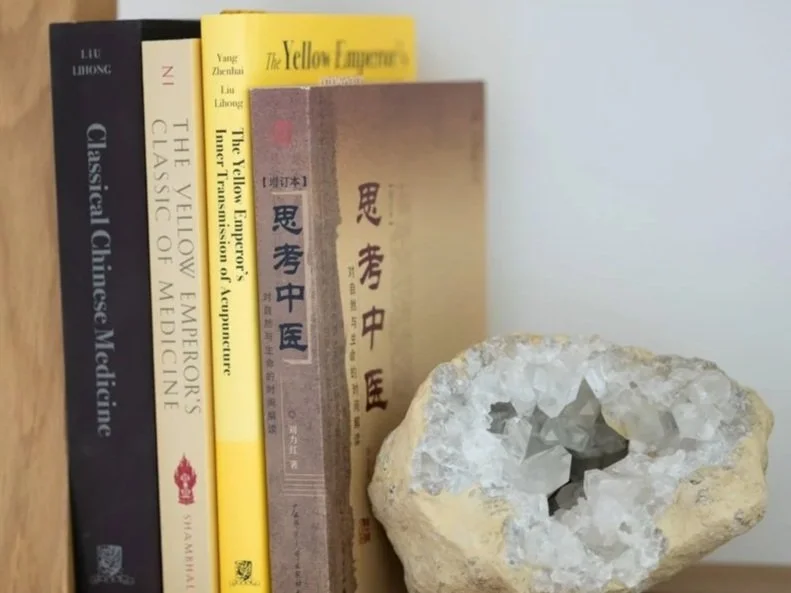
When we speak of Classical Chinese Medicine (CCM), we are referring to a vast body of knowledge that extends back well over two millennia. At its core are works such as The Yellow Emperor’s Classic of Medicine (Huangdi Neijing), a foundational and still highly influential text structured as a dialogue between the legendary Yellow Emperor and his ministers.
CCM developed as a scientific system rooted in a deep understanding of the relationship between the natural world and the human body – that is, on observing nature and drawing careful correspondences to the processes within our own selves. As a Five Element acupuncturist, my practice is grounded in this classical system. It remains a living tradition, adapting classical principles to changing circumstances, and I consider myself its lifelong student.
Traditional Chinese Medicine (TCM), by contrast, is not an ancient, unified system but a much more recent construct now taught within China and internationally. Formalised in The People’s Republic after the Communist Party took power in 1949, it represents a standardised interpretation of Chinese medicine – simplified and state-sanctioned, albeit with core ideas that long predate the twentieth century.
For acupuncturists in the UK and elsewhere, the distinction between CCM and TCM is far from academic. It influences how we understand diagnosis and engage with classical texts, and it continues to shape how acupuncture is understood and practised today.
A Question of Language and Perspective
Some practitioners reject the term ‘TCM’ altogether. The late author, lecturer and practitioner of Chinese medicine, Giovanni Maciocia, prefers simply ‘Chinese medicine’, noting that in China itself this term (zhong yi) is used in contrast to xi yi (‘Western medicine’). He also argues that ‘TCM’ as a term became popular largely through Western engagement with Chinese medical colleges. There is some truth in this, though it may oversimplify historical developments within China itself.
Maciocia’s observation that the term ‘traditional’ can be misleading has implications for clinical practice. It connotes a single, authentic lineage, whereas Chinese medicine has always been pluralistic. Given China’s size and diversity, it is far more accurate to think in terms of many local traditions rather than one uniform system.
Continuity and Change
It is tempting, but simplistic, to frame TCM as a complete break from tradition. As the clinician and researcher Volker Scheid points out, efforts to systematise Chinese medicine actually began before 1949. What we are witnessing is a complex interplay of continuity and change. All Chinese governments – Imperial, Republican, Communist – have shaped medicine in different ways. Yet practice on the ground has always retained a degree of independence from state control.
The Question of Transmission
The influential Chinese scholar and practitioner Liu Lihong has critiqued the ‘integration’ of CCM with Western science since 1949, and emphasises the importance of direct oral transmission between shifu (Teacher/Master) and disciple, an exchange he considers threatened by the tendency of TCM to draw closer to the means and modes of modern sciences.
If a modern-sciences paradigm is used in teaching Chinese medicine, Liu argues, ‘it is inevitable that many things will be lost in the process’. Because Chinese medicine ‘does not lend itself to the kind of generalisations possible in modern science’ – being a traditional form of medicine that is not dependent on technology (occurring instead ‘through the direct effort of practitioners’) – it follows that the form of education followed by CCM schools maintains continuity with the great body of Chinese medicine over millennia, and that TCM-style education may represent a rupture with these traditions.
A Growing Divide?
The eminent scholar and practitioner Heiner Fruehauf goes further, arguing that TCM represents not just a shift, but a potential threat to the integrity of CCM. He describes it as a system that seeks to ‘reform and control’ the classical tradition in the name of progress, and warns that it may lead to overly mechanistic approaches to healing.
While such views are openly acknowledged as opinionated, they raise important questions. If TCM becomes the dominant or exclusive framework recognised globally, what happens to the diversity of classical traditions? What is lost when a living, evolving practice becomes codified into a single model?
Most important is the recognition that what we call ‘Chinese medicine’ is not one fixed system, but a dynamic tradition shaped by history and human experience. That awareness can allow us to practise more thoughtfully, honouring both the depth of the classical tradition and the realities of modern clinical life.
Further Reading
Fruehauf, Heiner (1999), ‘Chinese Medicine in Crisis: Science, Politics, and the Making of TCM’. Journal of Chinese Medicine, October 1999.
Liu Lihong (n.d.), ‘Excerpts from Sikao Zhongyi [Contemplating Chinese Medicine]’.
Liu Lihong (2019), Classical Chinese Medicine, Hong Kong: The Chinese University of Hong Kong Press.
Maciocia, Giovanni (2005), The Foundations of Chinese Medicine, Edinburgh: Churchill Livingstone.
Scheid, Volker (2002), Chinese Medicine in Contemporary China: Plurality and Synthesis, Durham: Duke University Press.